
Inspired by a teaching course I took during my postdoc, this article brings together interesting insights that come not only from research but also from the experiences we carry as students and as scientists.
As scientists, we are primarily trained to do research and spend years learning how to troubleshoot experiments and analyze data. However, as our careers progress, many of us move from the lab bench to the classroom and realize that our training does not prepare us for teaching. Based on my experience as a researcher and mentor, along with what I learned from a teaching course as a postdoc, here are the aspects I found most useful for bridging the gap between the teaching and the classroom.
I also used many of my own experiences as a student to think about what I value and how learning can be approached in a more evidence-based way.
1. What is Teaching Philosophy and why does it matter?
The first step is to understand who you are when you stand in front of a class. This is your Teaching Philosophy, a personal roadmap that explains how you teach, why you choose those methods, and how you believe your students learn best.
Having a clear philosophy helps make better decisions. For example:
- If you believe in learning by doing, you’ll prioritize problem-solving over long lectures.
- If you believe confidence is important, you may encourage students to speak freely and give supportive feedback
- If you value real-world understanding, you connect lessons to everyday examples or case studies.

But to build a teaching philosophy, an important question comes up: how does the human brain process information?
2. The science of how we learn
One important idea is that learning is not just mental, it is also biological. When we learn, connections between brain cells get stronger. This is often explained as “neurons that fire together, wire together.” Some things can make learning easier or harder.
Motivation and curiosity: when students are interested or challenged, the brain forms more new connections.
Stress reduces learning: when students feel anxious or unsafe, it becomes harder for the brain to form memories.
Practice is important: actively using information, like solving problems or discussing, strengthens memory more than just rereading.
Metacognition: students think about their own learning, notice what they don’t understand, and adjust their approach.
If learning works best when students are active and reflective, then the most important part of teaching is putting those ideas into action.
3. Active learning & Storytelling
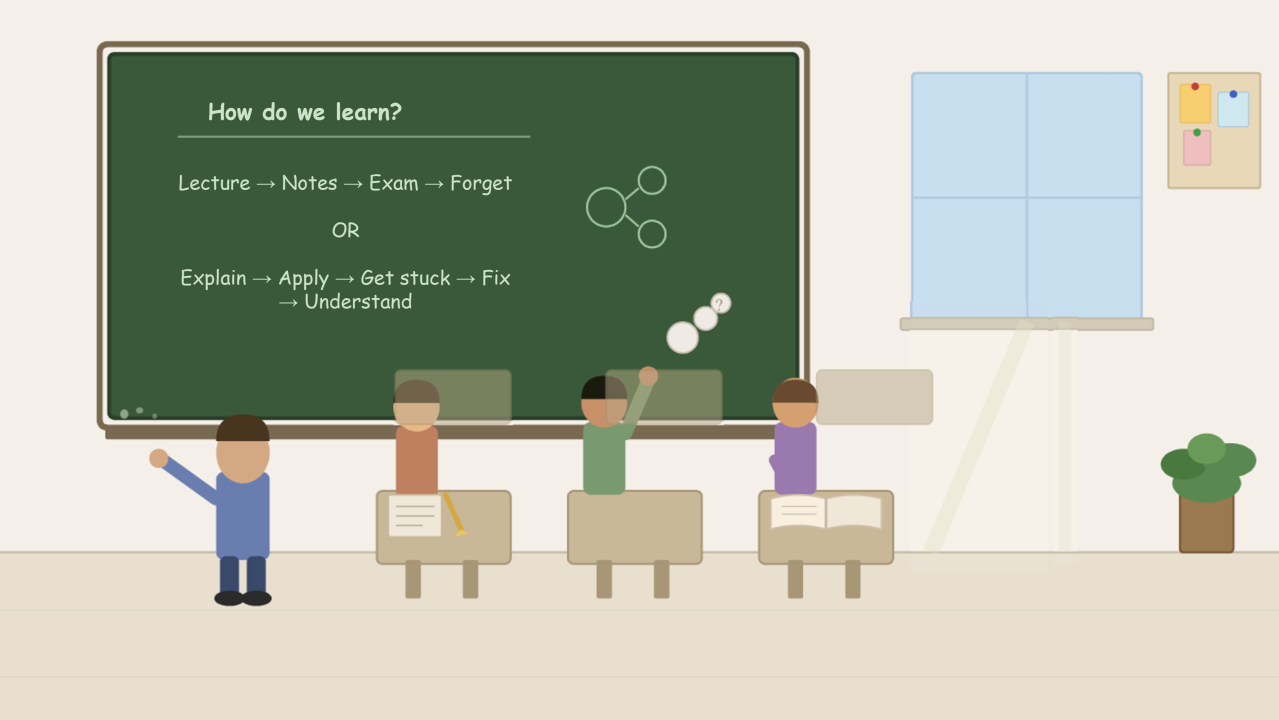
If we think back to our own time as students, just listening to lectures was rarely enough. Active learning means students are doing something with the info, like discussing, solving, or even teaching each other. One effective model is the flipped classroom, where students review basic material at home so class time can be used for deep-dive problem-solving.
Another interesting aspect is storytelling. A good story provides a clear structure (beginning, middle, end) that helps the brain process new ideas. In science, this might mean sharing the human story behind a discovery or using a vivid analogy to explain a complex pathway. But it is important that the story prioritizes learning and does not distract from the main idea.
4. Levels of thinking: Bloom’s Taxonomy
How do we know what level of understanding we want students to reach? Bloom’s Taxonomy helps us categorize the levels of thinking. Using structural biology (my area of interest) as an example, a simple progression can look like this:
- Remember: identifying an alpha-helix or naming amino acids.
- Understand: explaining how hydrogen bonds stabilize a fold.
- Apply: predicting if a drug will fit into a specific binding pocket.
- Analyze: comparing two protein structures to find conserved regions.
- Evaluate: judging if a 3D model’s resolution is high enough to trust.
- Create: propose a mutation in a protein to improve stability.

Many courses tend to stay at the first two levels of Bloom’s Taxonomy, where students mainly remember and understand information. This means they can recall facts or explain ideas but may not be able to use that knowledge in new situations.
5. Course design: Working backward
Designing a course is like planning a journey where you need a destination before you list the stops. Backward design involves three steps to guide that journey:
- Define the goal: what should students be able to do by the end?
- Plan the evidence: design the assessments that will prove they reached the goal.
- Create the roadmap: Choose the teaching methods and topics that lead directly to that goal.
This roadmap is then communicated through the syllabus. A good syllabus is a welcoming “user manual”, which should be clear, visual, and written in plain language to help students navigate the course.
6. Meaningful Assessment
After all the work, assessment is what we use to measure how much a student has learned. Just like the syllabus is the starting point, assessment becomes the final step, and both can feel stressful for students.
But assessments should not just be seen as hurdles. They should also act as tools for learning, and therefore they should:
- Match thinking levels: if you want students to “analyze” or “create” (the higher levels of Bloom’s taxonomy), don’t just give them true/false memory tests. The test should match the goal.
- Variety of formats: not everyone excels at one type of testing. Using a mix of quizzes, lab reports, and creative projects gives students different ways to show what they know.
- Low-stakes feedback: use small assessments frequently, like quick polls or one-sentence reflections. These provide regular feedback without the high stress of a final exam, allowing students to fix mistakes early.
- Real-world connection: whenever possible, link tasks to the “real world”, for example, instead of just defining a protein, explain how a specific protein structure relates to a disease or a drug’s effectiveness.
When it comes to visuals, especially in complex fields like biochemistry, simplicity is key. Following Mayer’s Principles, we should cut the clutter, use arrows or colors to guide attention to the most important parts, and break large complex diagrams into smaller digestible steps.
Another important concept is Universal Design for Learning (UDL), which focuses on designing courses for all students from the beginning. It focuses on providing multiple ways to consume information, to express understanding, and to stay engaged. Inclusive teaching improves outcomes for everyone, especially for students who might face challenges in a traditional high-pressure classroom.
The big takeaways
Looking at everything together, a few ideas that stand out:
- Teaching is a skill that can be learned and improved
- Students learn better by doing, not just listening
- The classroom environment has a strong impact on learning
- Good teaching requires alignment between goals, teaching, and assessment
By using approaches like UDL and active learning, we can bridge the gap between standardized education and the diverse ways students learn, making learning more accessible and meaningful.
Final reflection: A personal perspective
My interest in these methods is personal. As an introvert, I often needed a push to participate in the classroom. That experience taught me that every student is different, with unique personalities and ways of processing info.
While it isn’t always practical to have a fully personalized system, given constraints like class size and time, we can still create space for different strengths. Most students want to learn; they just express it differently.
Good teaching ensures we aren’t just testing memory (the bottom level), but helping students climb to the top of the pyramid, where they can actually use their knowledge.
Leave a Reply